
LILA PLANT DRAMA
This spring, take a moment to step away from the noise. Step outside. Take your time. Let nature set the pace.
“How should Spring bring forth a garden on hard stone? Become earth, that you may grow flowers of many colours. For you have been heart-breaking rock. Once, for the sake of experiment, be earth” – Rumi
A quiet surprise on our windowsill.
At first it’s almost unnoticed, a softness in the light as the mornings begin to feel a wee bit different. The Sun rises across the meadows gently, slowly reaching all the way from Arthurs Seat to our window just a minute or two earlier each morning. The crocus on The Meadows have already retreated, followed by snowdrops, daffodils, now the pink haze of the cherry blossom has already begun! Our aloe vera, sitting quietly, steady, patient, and often overlooked has sent us a flower, reaching gently toward the light. From its roots a tiny wee ‘pup’ is appearing through its soil. Isabel, our resident horticulturalist, informed us that this is a rare moment, something that only happens when the plant is truly settled, mature, and content in its surroundings. Santosha – there’s something comforting in that. No rush, no drama, just time, care, and the right conditions coming together when they’re ready.
Some say it’s a sign of good luck and prosperity. Maybe it’s also a reminder that growth doesn’t always shout. Sometimes it unfolds quietly, right in front of us. What an honour to witness this small, beautiful full circle of life playing out on our windowsill.
Pure joy!
This spring, take a moment to step away from the noise.
Step outside.
Take your time.
Let nature set the pace.
Here are a couple of suggestions to reconnect with our inner self through nature and a meditative practice this Spring.
Firstly, switch off your phone! Leave the urgency behind, and wander slowly through the meadows, beneath the canopy of trees. Pause often. Look closely. On every branch, in every rustle of leaves, quiet dramas unfold, tiny worlds continuing, unnoticed, unless we choose to see them.
Pranayama
भ्रामरी (Bhramari)
Pranayama – or Bee Breath – is a humming breath practice. In Sanskrit, Bhramara means “big black bee”. Bhramari is one of several Pranayama techniques described in the 15th Century text The Hatha Yoga Pradipika by Swami Swatmarama.
Find a spot, sit under a tree or lie down on the grass. Place your fingers gently over the cartilage of your ears. Begin to hum through the exhale, feel the vibration on your lips and hear the soft sound of a bee. It stimulates the vagus nerve and activates the parasympathetic nervous system, a perfect Pranayama practice to enjoy outside –enjoy!
Tadasana
ताड़ासन (Tāḍāsana)
Tadasana – or Mountain Pose – is the foundation of all standing postures, a moment of simply being. There is no striving here, no goal to reach, just quiet presence. Take off your shoes, wiggle your toes, imagine roots descending from the soul of your feet deep into the earth as the crown of your head reaches for the sky. Soften your gaze, or you might like to close your eyes, just for a second feel the support and balance from the Earth. Feel the drama of nature surrounding you. Take it in, connect to it with no attachment to any outcome.
Shinrin-Yoku
The Japanese art of “Forest Bathing”. The idea is to let the forest enter you through your senses rather than you simply passing through it. In places like the Hermitage of Braid and Blackford Hill, just 10 minutes from Lila, that kind of mindful wandering can feel almost transformative.
Listen to subtle layers of sound, wind through leaves, birdsong, distant rustling;
Touch textures, tree bark, cool stones, the air itself;
Smell the organic earth, moss, wood;
See without rushing, light, patterns, colours;
Taste the air, freshness, dampness.
This gentle attention can open up a quiet emotional clarity. An unforced joy, calm or reconnection that feels almost like rediscovering something misplaced. Like crossing a bridge from mental noise into simple presence. Try just walking with no destination. Just notice. That’s often where the ‘joy’ or Santosha slips in quietly, not dramatically.
A simple, beautiful walk in the forest!
Surya Namaskar A (Sun Salutation A)
सूर्य (Surya) | नमस्कार (Sun Namaskāra) | greeting – salute – bow
Why not try this practice outside on a sunny morning? A traditional, foundational yoga practice that invites you into a deeper connection with your true nature through meditative movement. With each breath, there is a gentle dialogue between body and feet rooting, spine rising, awareness softening. Allow the mind to naturally settle, revealing a quiet sense of calm. There is nothing to achieve, nowhere to arrive…Again, no outcome. And of course, use any props you may need, a park bench or a tree to help steady.
Try this Surya Namaskar A Sequence:
Samasthitihi (Standing Pose): Inhale/Exhale.
Urdhva Hastasana (Upward Salute): Inhale, arms up, gaze at thumbs.
Uttanasana (Forward Fold): Exhale, fold forward.
Ardha Uttanasana (Halfway Lift): Inhale, lengthen spine.
Chaturanga Dandasana (Four-Limbed Staff Pose): Exhale, jump/step back and lower.
Urdhva Mukha Svanasana (Upward-Facing Dog): Inhale, chest open.
Adho Mukha Svanasana (Downward-Facing Dog): Exhale, hold for 5 breaths.
Ardha Uttanasana (Halfway Lift): Inhale, jump/step forward.
Uttanasana (Forward Fold): Exhale, fold.
Urdhva Hastasana (Upward Salute): Inhale, rise up.
Samasthitihi: Exhale, return to standing.
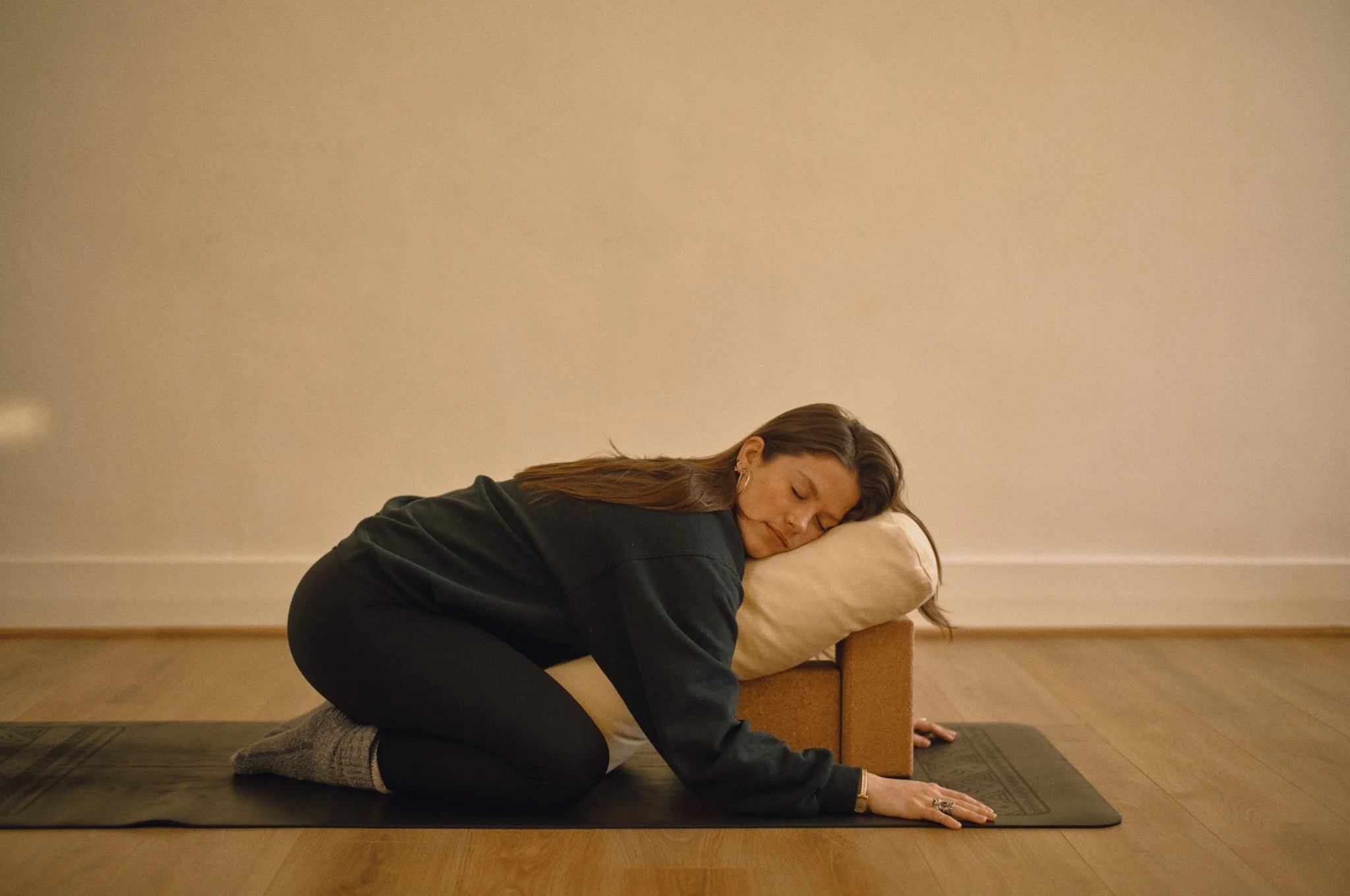
The final weeks of winter are a sanctuary
Spring will come. When it does, may we meet it not exhausted, but rooted.
As the light begins to rise earlier in the mornings and slowly stretches longer each evening many of us feel the need to rush forward into Spring. We are tired of the cold, yet perhaps not quite ready for spring’s outward bloom, if we’re honest with ourselves. These last couple of weeks of winter need not be rushed. They can be sacred.
In yogic philosophy, life moves in cycles - expansion and contraction, effort and surrender. Winter aligns with apas (water) and tamas (inertia, heaviness). Instead of resisting this slower rhythm, we can work with it.
These final winter weeks are ideal for:
Restorative and yin yoga ~ long held, supported shapes that nourish the nervous system
Pranayama practices ~ like nadi shodhana (alternate nostril breathing) to balance and conserve energy
Journaling and reflection ~ asking what wants to be composted before spring
Earlier evenings and deeper rest
Rather than pushing productivity, we can ask:
Where can I soften? Where can I store energy instead of spending it?
In Ayurveda, this period often overlaps with late kapha season - grounding, dense, and slow. Gentle warmth (teas, slow movement, community connection) supports balance without depletion. Yoga reminds us that we are relational beings. The Sanskrit word seva (selfless service) teaches that care flows both ways. Conserving energy isn’t for our isolation; it’s intentional stewardship so we can show up sustainably for others.
Community care in late winter might look like:
Hosting a small, cozy potluck instead of a big gathering
Checking in on neighbours who may feel isolated
Sharing childcare or meal prep to reduce collective strain
Practicing collective rest - a group meditation, a slow Sunday circle
We can practice community care and resist burnout culture together.
Try this 20/30-minute sequence designed for nervous system maintenance and support:
Supported Child’s Pose (Balasana) 5 minutes
Seated Forward Fold (Paschimottanasana) soften, no striving
Legs Up the Wall (Viparita Karani) restore circulation, calm the mind
Nadi Shodhana 5 slow minutes
Savasana with weight or blanket stay longer than you think you should
Move slowly. Transition gently. Let stillness be the teacher.
Nature does not bloom year-round. Seeds need darkness.
If we overextend now socially, professionally, energetically, we enter spring already depleted. But if we treat these weeks as intentional incubation, we step into the next season resourced.
Ask yourself:
What habits am I ready to shed before spring?
What boundaries need strengthening?
Where can I practice softer ambition?
Spring will come. When it does, may we meet it not exhausted, but rooted.